Young Exoplanets
Stellar rotation gives us stellar ages. When the star hosts a planet, this in turn gives us the age of the planet. Knowing the age of the planet helps us learn more about what types of planets can exist at different ages and how planets form. Here are a couple examples of papers where I have helped with the analysis.
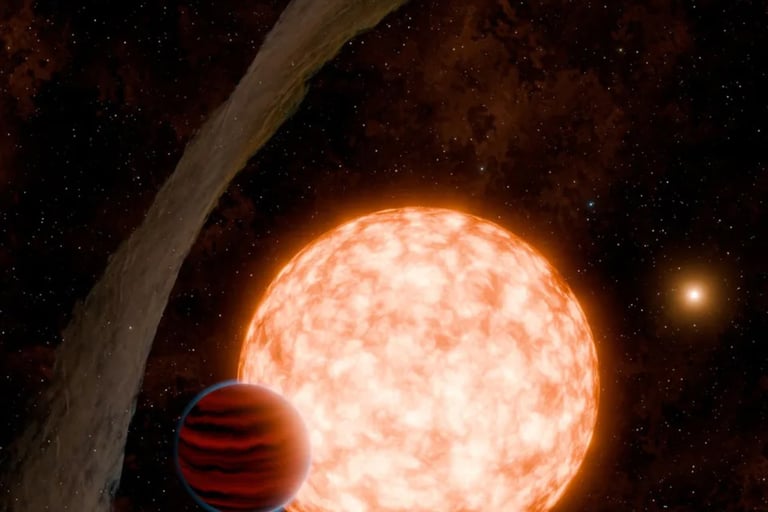
A Giant Planet Transiting a 3-Myr Protostar with a Misaligned Disk
Led by Madyson Barber. The goal of this project is to understand how early planets can form and be detected by searching for transiting planets around extremely young stars. By analyzing TESS data and follow-up photometry, spectroscopy, and imaging, we confirmed a transiting planet, IRAS 04125+2902 b, orbiting a ~3 Myr pre–main-sequence star in the Taurus star-forming region. At time of writing, this is the youngest known transiting planet and likely a precursor to sub-Neptune or sub-Saturn planets, providing rare observational evidence that planets can form and migrate within a few million years.
Searching for Transit Timing Variations in Young Transiting Systems
Led by Isabel Lopez Murillo. The goal of this study is to determine how common transit timing variations (TTVs) are among young planetary systems and assess whether they can be used to measure the masses of young planets. To answer this question, we analyzed light curves from Kepler, K2, and TESS for 53 planets younger than 800 million years, measuring individual transit times to search for deviations from strictly periodic orbits. We found that young planets exhibit TTVs at three times the rate seen in older systems, suggesting young planetary systems are more dynamically interactive and that TTVs may be a powerful method for measuring their masses.